Monday, 21 May 2012

Boltzmann's Eye - Fourth Printing!

I'm pleased to announce the fourth printing of Tales of the Hollow Earth Issue 1 with a brand new colour cover.

This new printing, to the infuriation of everyone who has purchased previous editions and for whome a deal can be made, features re-toned interiors to match issues 2 and 3, a colour cover and five extra interior pages.

The new colour pages include Lure - a Gudrun Black tale which first appeared in A4 Comics Presents, edited by Daniel Clifford, and a new single pager.

Here's the cover:


This new edition will be launched at the This is Where it's Art festival in Spennymoor, which really is the place to be in the North East of England on the weekend 8th-10th of June.

Wednesday, 11 April 2012

Newcastle Mini Comics Making 2012

Blimey this year is running on a bit fast? A few plans in the pipeline and a few starting to pop out the other end.

First up: I'll be doing a talk on comics at Newcastle City Library next weekend (21st April) as part of the Newcastle Mini Comics event organised by the inestimable Cuttlefish Comics.

My talk is called 'Comics: Words + Pictures where Space = Time' It's all about what I know about storytelling on a comic book page and how the composition of the panels is used to control the passing of time. It's also about the accessibility of the medium because of the way in which the participates in the telling in a way that differs from film and prose.


Dispensing a powerful dose of comics wisdom will be Ingi Jensson, whose tale of how he burned-up, then rose out of the ashes, found his mojo and personal style will get people's heads properly screwed on for the dangers that await them as they embrace their own creativity.

And embrace it they will, for after the talks will be the Mini-Comics day proper, when we will all be getting down and making comics from scratch.

Mini comics

The event is free but you'll need to book and places are limited: Book your place by phoning 0191 2774100 or by emailing information@newcastle.gov.uk.

Monday, 23 January 2012

The Twenty Three : Number None : Lure


The Twenty Three is a website i'm setting up to contain extras, extended scenes, b-sides, outtakes and brand new stories from the Tales of the Hollow Earth universe. It will all be material that adds to the story, but some of which i'm discarding from the printed comic in order to concentrate on the main plotline.

The Twenty Three : Number None : Lure

Lure, for example, introduces elements of Gudrun Black's character that would be useful to a reader of issue 3, so it's getting reprinted here, as well as in a coloured version in the next edition of issue 1.

It originally appeared in Daniel Clifford's A4 Adventure Arena. Daniel provided input on pacing and storytelling and made this a much tighter story, and I'm greatful for this and his permission to reprint.

Wednesday, 11 January 2012

Comics: words + pictures where time = space

So, last night I did a presentation for Design Interest under the title "Comics: words + pictures where time = space", the aim of which was to talk around some of the issues of time and space in comics. The evening was excellent - good bunch of people and I had excellent fellow speakers, Rose Mockford (@mydesignmade) and Liz Douthwaite. Vicki Teinaki's take on the evening can be seen here.


Comics Time as in how long a comic takes to produce and read, as well as noting that time is in the hands of the reader.

How can the creator control both the perception of time in the story, as well as the time it takes to read - in order to properly pace a joke, for example?

Here's what I talked about, in brief, but in roughly the same order...


1,2,3,4

  • Steve Bell - Political Cartoons are usually single panels, since the story is happening elsewhere. A single panel is still read from left to right, though and is not read as a single moment in time. 
  • Jack Comics - Provided the example of images colliding and suggesting stories.
  • Penny Arcade - An example of the standard format three panel web strip, and referenced Jimmy Carr's definition of a Joke as two stories colliding. Again, most of the story is not in the strip but in the archives and newsposts.
  • Scott McCloud - Understanding Comics - is of course, essential reading.
  • Calvin and Hobbes - Provided several example of the standard format four panel newspaper strip (a complete story being told in four panels.) as well as larger format illustrations of good pacing.
  • Tim Stout - Provided the Calvin and Hobbes example of a three act structure ready made exactly as I'd planned already, but with a better example.

Comics in Time and Space

This section focused on the accessibility and availability of comics and why and when this would make for good documentation, dissemination and education.


The Axis of Empathy


The Big Triangle was invented by Scott McCloud, minimalism on the horizontal axis, abstraction on the vertical.


Photo from http://twitter.com/vickytnz
In my examples (pictured), I had, moving up from reality towards abstraction...

Moving back from abstraction towards minimalism and empathy...

And in the middle I had...

Subsequent slides contained examples of charicature used in horror and dark tales from...

Time and Space in Comics


There was a lot of cross over between these examples, but broadly, I showed:


Comics using the full bleed to show that the edge of the page connects to bigger things:

Comics using a grid (and colours) to suggest (and then subvert) monotony and inevitability:

Subverted to devastating effect in:

Comics using full width panels to show an indeterminate, but lengthy, timescale:
Recommended Reading:

  • but most of all, for the best showcase of what's happening now in comics: 2000AD
  • and also, meet up with the Paper Jam Comics Collective on Thursday evenings in Newcastle's Travelling Man store. Follow @paperjamcc on twitter.

Friday, 30 December 2011

Thinking about Comics - things of interest.

Things I read that made me think differently or just more about comics in some way or other in the last year (or so). Here's a post to remind myself what they all were.

Sugar Glider 2 - by Gary Bainbridge and Daniel Clifford

Raising it's already impressive game from Issue 1, Sugar Glider 2 introduced new ideas, new characters and achieves a strong sense of place and being there. The difference between how this is handled in 1 and 2 is well worth looking closely at.

The "I'm Sugar Glider" panel is one of my favourite comic panels of the year. I know that both Gary and Daniel take their storytelling very seriously, and there are some sections of this that I've been back and forward over to see how they work. I'm really looking forward to issue 3. It's good.


Low Life - by Rob Williams, and D'Israeli (created by Rob Williams and Henry Flint)

I've read the latest two series of this in 2000AD, and so not knowing his history I'm never quite sure what Dirty Frank is capable of. This is possibly the point: his antagonists, and possibly also he doesn't either. Or if he will even do what he is capable of once he does know. Dirty Frank is a brilliantly imagined character: fragile and powerful in unexpected ways.

Stories that are both strong, character driven and laugh out loud funny. Low Life, Zombo (Al Ewing and Henry Flint) and Dredd (John Wagner mostly) are all capable of achieving this, and I'm pleased to say that 2000AD has definitely reclaimed it's place at the top of my must read list in the last two or three years.

Actually, the other thing that Low Life, Zombo and Dredd are capable of is managing to fit a story into five page episodes: always introducing the scene for new readers, always maintaing the pace for existing readers, either week on week or in collections.


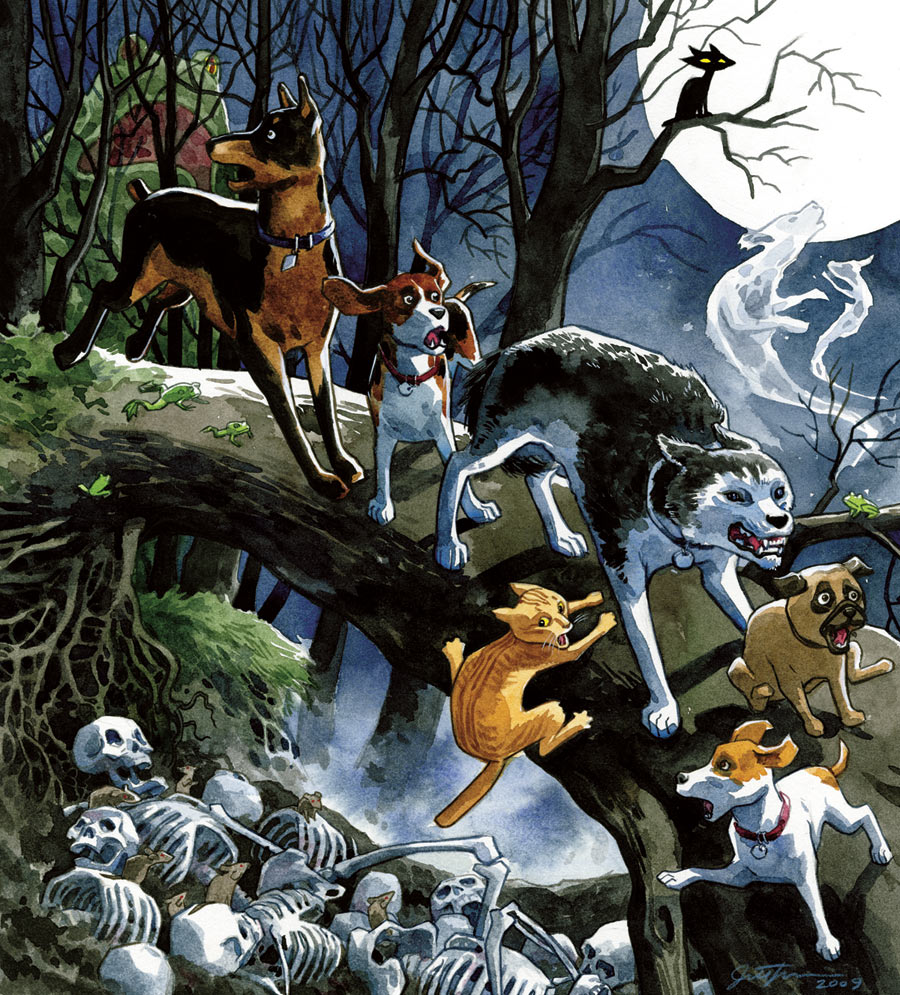
Beasts of Burden - by Evan Dorkin and Jill Thompson

Splendid. A while ago I started writing some short stories (as part of my Story a Day in May) about a tribe of Rats, and would really like to translate these into comics and expand on them. I've not been able to figure out how to do animal comics without anthropomorphising them physically to some degree (A topic covered also in Bryan Talbot's excellent talk on the subject which i've seen three times now) or giving them the ability to carry swords of wear monocles.

Beasts of Burden shows how this can be done: in both the words and pictures. It a beautiful book, and I'm not sure enough people have read it. You should.


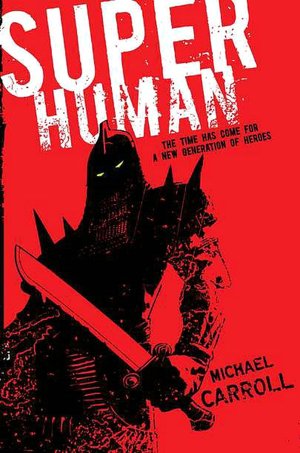
SuperHuman - by Michael Carroll

The first of (I believe) the second sequence of New Heroes books from Michael Carroll, which Michael very generously swapped for my own Tales of the Hollow Earth. Strong characters here, and strong development too including a very dark and not yet resolved subplot for the heroes.

This is a novel rather than a comic, though it tackles comics traditional subject matter and is actually pitched much more at comics traditional expected audience than comics currently are. Very difficult to imagine though, what format this would have taken if it was a comic, or why Michael chose prose rather than comics for this story (he is also a writer for 2000AD and the Megazine).

So, I'm planning to read more of these in 2012, as I really want to think more about this and also read more about these people - especially that of the main villain. He did seem to have been on the cusp of some self awareness in the final few pages, but this may be unlikely as those pages may have been his last. We'll see.


I might re-read Wild Cards too.


The Lovecraft Anthology (Volume 1 Edited by Dan Lockwood)

Following 2010's best single web comic: His Face All Red, i'd been thinking a lot about horror (or comics of a dark nature) and how they appear to be working best when drawn in a cartoony or ligne claire style (see also Cinebooks excellent 'Green Manor').

Understanding Comics 101 would say the minimalist creates empathy and this more nieve style might imply that the characters are childlike in their fragility, but I think that there's more to why thus combination works yet. I think horror may be the best genre in which to ask the question: how are comics different to books and films.

Anyway, the Lovecraft anthology from Self Made Hero is a pretty beautiful piece of work (as are all of the books they publish), and it would be remiss of me not to point out that the many talented artists and writers successfully do in fact find ways to express unimaginable horror in comics. That's some achievement.


Nic Wilkinson and Ian Sharman's Lettering Workshop at ThoughtBubble 2011.

This was not a technical talkas I'd expected, but was instead focused very much on artistic and storytelling concerns of relevance to not just the letterers but artists and writers also. Some very interesting points were made on the subject of reading order and pacing control that I've yet to fully process, but I have been back through my own work with an eye on 'what should I have done here'.


---

So, yeah, those were, for me, an great set of examples on why and how comics forms and formats work, how they differs from other mediums and how they are better or worse for some genres than others. All are well worth your time.

Sunday, 18 December 2011